
 By
By 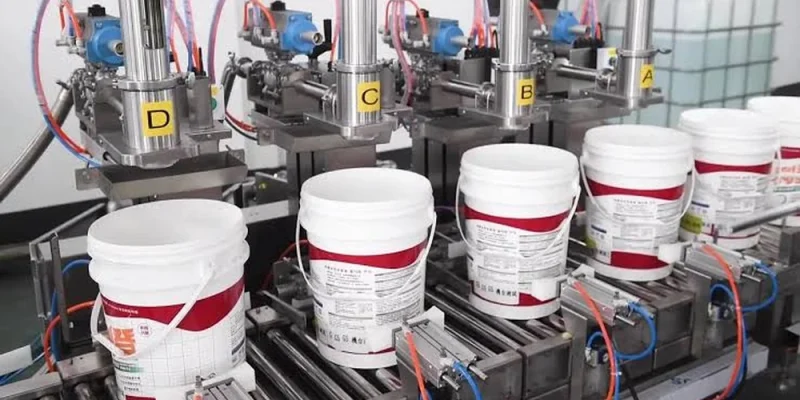
Filling twenty-litre pails by hand is one of those tasks that looks manageable until you cost it properly. Two operators, a hose, a set of scales, and a rate that drops through the afternoon as people tire. The spillage is accepted, the overfill is invisible, and the back strain shows up in absence records rather than on the production report. A pail filling machine changes all four of those figures at once.
Where the Time Actually Goes
Manual filling is not slow because pouring is slow. It is slow because of everything around it: positioning the empty pail, aligning the nozzle, watching the level or the scale, stopping at the right moment, moving the full pail away, and correcting the ones that were over or under. An automatic system compresses that cycle to a repeatable few seconds and, more importantly, makes it identical every time regardless of who is on shift or how late in the day it is.
Accuracy and the Cost of Giveaway
The quiet expense in manual filling is overfilling. Operators fill generously because underweight containers cause complaints and rework, so a systematic overfill of one or two percent becomes normal. Across a year of twenty-litre pails that is a substantial volume of product given away without being invoiced. Automatic systems with weigh cells or calibrated flow measurement hold a tight tolerance, and the recovered giveaway alone frequently funds a meaningful share of the equipment.
Matching the Method to the Product
Free-flowing liquids suit gravity or flow-meter filling. Viscous products such as lubricants, resins, adhesives and pastes need positive displacement, usually a piston or lobe pump. Foaming products require a diving nozzle that descends into the pail and fills from beneath the rising surface, retracting as it goes, which prevents the foam that ruins fill accuracy. Give any supplier the viscosity at working temperature, the foaming tendency and the chemical characteristics before discussing machines.
Weigh Filling Versus Volumetric
Volumetric filling measures the quantity delivered and is simpler. Weigh filling places the pail on a load cell and fills to a target mass, which automatically compensates for density changes with temperature and between batches. Where a product is sold by weight, or where density varies, weigh filling is generally the more accurate and the more defensible approach. It also produces a record of each fill, which matters where traceability is required.
Single Head, Multi-Head and Line Speed
A single filling head suits modest volumes and is the usual starting point. Multi-head systems fill several pails simultaneously and suit higher throughput, at greater cost and complexity. There is also a two-stage approach where a fast bulk fill is followed by a slow dribble fill to hit the target accurately, which gets most of the speed of an aggressive fill with the precision of a gentle one. Suppliers of pail and jerry can filling equipment will size this against your actual daily volume rather than a peak figure.
The Stations Around the Filler
A filler in isolation moves the bottleneck rather than removing it. Empty pails have to arrive singulated and upright, which is what a denester does. Full pails have to be lidded, which a capping or lid press handles. They then need labelling and palletising, and a full twenty-litre pail is heavy enough that manual palletising is both slow and a genuine injury risk. Automating the filler while leaving palletising manual is a legitimate choice, but it should be a deliberate one.
Cleaning and Changeover
Anything handling more than one product needs cleaning between runs, and how easily that is done determines real throughput. Ask how the wetted path is drained and cleaned, whether it can be flushed in place, and how long a product changeover takes. Ask how a container size change is performed and whether settings are stored as recipes. An operation running many SKUs in short batches will find changeover time matters more than nominal filling speed.
Safety and the Working Environment
Guarding, interlocks, emergency stops and safe access for cleaning are requirements rather than extras. Where solvents or flammable products are handled, the area classification determines what equipment is permissible, including motors, sensors and electrical enclosures, and bonding and earthing to control static becomes essential. Specify this at the outset, because a machine chosen without regard to the atmosphere it works in cannot be brought into compliance cheaply afterwards.
Semi-Automatic as a First Step
Full automation is not the only option and is frequently not the right first one. A semi-automatic filler, where an operator places the pail and presses a start button while the machine controls the fill itself, captures most of the accuracy benefit and much of the speed at a fraction of the cost. It also removes the part of the job that causes overfill, which is human judgement about when to stop. For operations filling a few dozen pails a day, or those wanting to prove the case before committing capital, this is often where the sensible investment sits, with the option of adding automatic handling later.
Justifying the Investment
Measure the current state honestly: pails per shift, operators on the task, average overfill, spillage, rework and downtime. Then model the same figures with the machine, include installation, commissioning, training and the production disrupted during changeover, and calculate a payback period. For most operations filling in any volume, the case for a pail filling machine rests less on speed than on the giveaway recovered and the labour redeployed, and those two lines are usually enough on their own.










Comments